A major infusion of federal funding is poised to give Michigan State University’s plant scientists a powerful new weapon in the fight against some of agriculture’s toughest challenges.
The U.S. Department of Agriculture’s National Institute of Food and Agriculture has awarded more than $16.2 million to MSU for the continued renovation and modernization of its Plant Science Research Greenhouse Complex.
With MSU providing the required matching funds, the award creates more than $32.5 million in new support for the project — the third-largest award among the $121 million in research-facility investments announced nationwide through USDA NIFA’s Research Facilities Act Program.
For farmers and Michigan’s agricultural industries, the investment goes well beyond bricks, glass and high-tech equipment.
It is about giving researchers the controlled environments they need to find answers faster — from emerging pests and diseases to extreme weather, water stress, crop improvement and plant resilience.
“In a state with an unpredictable growing season, our greenhouses are critical for plant research,” said Eric L. Hegg, dean of MSU’s College of Natural Science. “This funding will give our faculty quality spaces and controlled environments to do what they do best — the unseen but vital research that lays the foundation for farmers, plant breeders and agricultural innovators to better feed the world.”
40% of Greenhouses Still Need Major Upgrades
MSU has already invested heavily in the greenhouse complex.
Approximately $40 million in funding from the State of Michigan and MSU units has supported new construction and renovations covering roughly 60% of the research greenhouses.
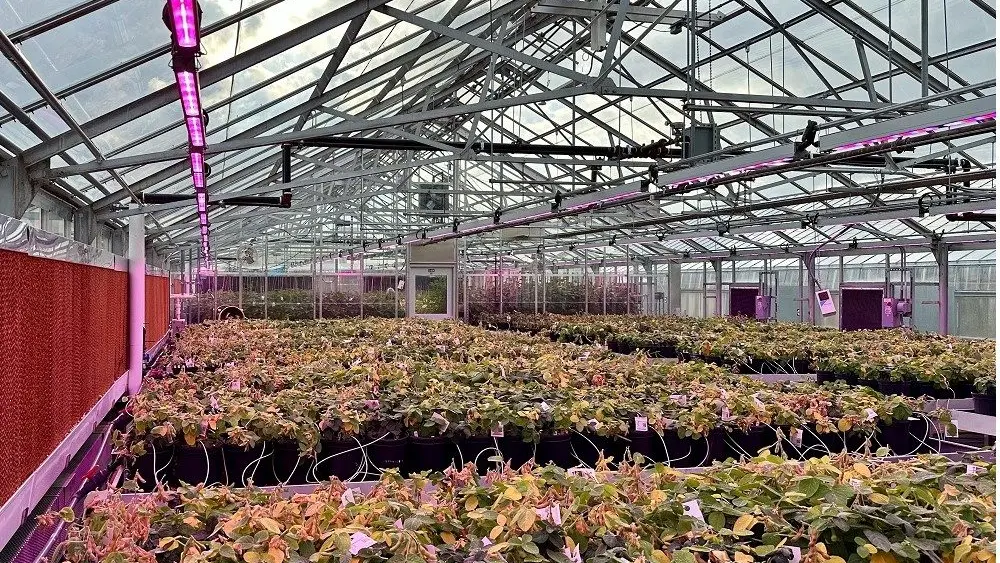
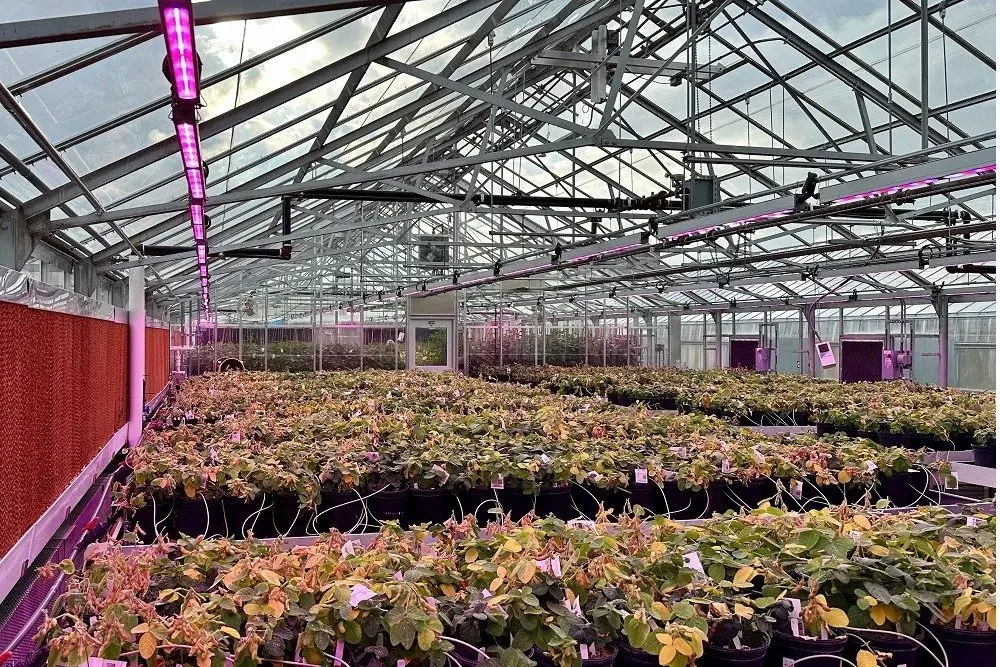
Those improvements have included a new headhouse, modern environmental control systems, LED lighting, upgraded glazing panels and taller ceilings capable of accommodating larger crops.
But a significant gap remains.
About 40% of the greenhouse complex had received little to no modernization when the latest phase of the project was completed in April 2026.
The new USDA funding is designed to help close that gap.
The remaining facilities will receive modern LED lighting, improved environmental controls and taller ceilings. Researchers also will gain automated shade and energy curtains, allowing them to precisely manipulate light exposure, temperature and humidity while improving energy efficiency.
For researchers, that precision can make the difference between an experiment that is possible and one that isn’t.
Erik Runkle, an MSU professor and Extension specialist in the Department of Horticulture, said temperature and light are two of the primary drivers of plant growth, making reliable control of those factors essential.
The upgraded facilities will also remove physical and environmental limitations that have restricted research involving tall crops, drought and pest-control studies.
“The new facilities will give us much tighter and more reliable control of temperature and light,” Runkle said. “They will also eliminate research barriers, such as height restrictions on tall crops and obstacles in drought studies and pest control research.”
A Direct Connection to Michigan Farmers
The stakes are particularly high for Michigan agriculture.
Michigan has one of the most diverse agricultural sectors in the nation, including major fruit, vegetable and specialty-crop industries. But that diversity also exposes growers to a wide range of threats, from insects and diseases to unpredictable weather and water conditions.
MSU’s greenhouse complex provides a critical controlled environment where scientists can recreate those challenges and study how plants respond.
That work is supported through programs including Project GREEEN and the Agricultural Resiliency Program, both administered through MSU AgBioResearch and MSU Extension and funded by the State of Michigan.
Project GREEEN focuses on emerging plant-agriculture issues such as insect and disease control, while the Agricultural Resiliency Program targets longer-term, cross-commodity challenges involving extreme weather and water.
Nancy Nyquist, executive director of the Michigan Blueberry Commission and Michigan Tree Fruit Commission, said modern greenhouse infrastructure gives growers an important line of defense.
“Upgrading MSU’s controlled environment facilities allows researchers to simulate real-world threats in real-time, delivering the fast, actionable data that our fruit, vegetable and specialty crop industries need to remain competitive and resilient,” Nyquist said.
That capability is especially important for specialty crops, where private-sector research dollars can be limited.
Building Agriculture’s Next Generation of Solutions
The renovated greenhouses will support more than 400 users from MSU’s College of Agriculture and Natural Resources and College of Natural Science.
The facilities also serve some of the university’s most prominent research programs, including the Department of Energy-funded Plant Research Laboratory and the Plant Resilience Institute.
Researchers at the Plant Research Laboratory have spent more than six decades studying the fundamental processes that allow photosynthetic organisms to function, with the long-term goal of developing technologies that improve lives.
Scientists with the Plant Resilience Institute are studying how plants respond to increasingly unstable environmental conditions — work that could become increasingly important as growers face more volatile weather patterns.
Chad Cotti, interim director of MSU AgBioResearch, said the new infrastructure will help MSU build on its reputation as a global leader in plant science.
“This funding strengthens our mission of finding solutions to the major challenges facing plant agriculture in Michigan, across the U.S. and all over the world,” Cotti said.
Michigan agricultural organizations also played a role in helping MSU secure the federal investment, submitting letters of support to USDA NIFA.
Chuck Lippstreu, president of the Michigan Agri-Business Association, called the award a historic investment in Michigan agricultural innovation.
He said the modernized greenhouse facilities will strengthen research ranging from plant breeding and variety improvement to disease and pest resilience.
More Than a Greenhouse Project
MSU College of Agriculture and Natural Resources Dean Matt Daum said the federal investment recognizes the importance of research infrastructure to the future of agriculture.
The USDA NIFA Research Facilities Act Program specifically supports construction, alteration and modernization of facilities used for agricultural research, teaching and Extension — while helping train the next generation of researchers and agricultural professionals.
For Michigan farmers, however, the value ultimately will be measured in what comes out of those facilities.
- A new crop variety that handles disease better.
- A pest-management strategy developed before an emerging threat reaches commercial fields.
- A plant that performs better under drought or extreme temperatures.
- A more resilient production system capable of withstanding an increasingly unpredictable growing environment.
Runkle said that once the greenhouse renovations and MSU’s Plant and Environmental Sciences Building are completed, the university will have one of the largest and most sophisticated plant-growth research facilities in the country and beyond.
And for Michigan agriculture, that could mean something even more important:
More research capacity. More answers. And a faster path from the laboratory to the farm.